May 18, 2026 · 8 min read
Your Parents in India Are Storing Their Medical Records in a WhatsApp Family Group. It Is Time to Admit That Is Not a System.
The WhatsApp Family Group Is Not a Filing System
Open the WhatsApp group your family uses. Scroll up. You will find, somewhere between birthday wishes and forwarded good morning messages, a JPEG of your father's lipid panel from August. A blurry photo of your mother's ECG that your sister took at the cardiologist's office. A screenshot of a prescription typed out by your brother because the doctor's handwriting was unreadable. A voice note from your aunt describing the dosage of your dadi's diabetes medication.
This is not a healthcare record system. This is a graveyard of medical documents scattered across a chat thread that nobody can search, nobody can sort, and nobody can hand to a doctor in an emergency.
Every Indian family, in 2026, is running its elders' health admin this way. The diaspora son in Toronto, the daughter in Frankfurt, the cousin in Bengaluru, and the parent in Coimbatore are all looking at the same JPEG, none of them sure when it was taken, all of them assuming someone else has the original. This works fine until the day it stops working, and the day it stops working is usually the day it matters most.
What the Data Says About India's Ageing Reality
India is ageing faster than most of its institutions are ready for. The United Nations Population Fund reports that the country's elderly population is projected to make up 20 percent of the total population by 2050. That is roughly one in five Indians, over the age of 60, within the working lifetime of someone reading this blog.
More relevant to the daily experience of these seniors: 65 percent of Indians aged 60 and above have hypertension. Elevated blood pressure is accountable for around 54 percent of stroke cases and 47 percent of coronary heart disease occurrences in this country. Indians develop heart conditions 5 to 10 years earlier than other ethnic groups, and 52 percent of cardiovascular deaths in Indians occur before the age of 70, compared to 23 percent in Western populations.
These are not abstract statistics. They describe a country where an enormous share of senior citizens live with conditions that can produce a medical emergency, often suddenly, often when their adult children are not in the country. Stroke and heart attack are the two largest categories of these emergencies, and both are time-critical to a degree that most Indian families do not internalise until they are inside one.
Why Your Father's Cardiologist Is Mentally Stored in Your Mother's Head
Walk into any 65-year-old Indian uncle's house and ask him who his cardiologist is. He will pause, look towards the kitchen, and shout the question to his wife. She will answer. Ask him what his last lipid panel said. Same routine. Ask him what dose of his BP medication he is currently on. He will pull out a prescription that may or may not be the most recent one, depending on which drawer it ended up in.
This is not a critique of him. It is a portrait of how Indian households have always managed health information: the husband's body is monitored by the wife's memory. The wife's body is monitored by her own memory plus a handful of papers. When the children were at home, they were the secondary backup. Now the children are in another country, and the backup has gone quiet.
The deeper problem is not that the information is disorganised. It is that it exists in exactly one place: inside another person's head. When that person is also the patient, or when that person is also having a medical event, the entire system collapses in the same moment it is most needed. Indian households have been running health record management on a single point of failure for generations. The gig economy and the diaspora have simply made that failure more likely to be fatal.
The Stroke Window Your Neighbour Cannot Use
Stroke has a treatment window called the golden hour. More precisely, for clot-dissolving thrombolysis to be effective, it must be administered within three to four and a half hours of symptom onset. Every thirty minutes of delay in receiving clot-busting treatment during a stroke reduces the chance of a good recovery by roughly 20 percent. The ambulance, the ER intake, the imaging, the neurology consult: all of this has to happen within a window that begins the moment your father's face droops on a Tuesday afternoon.
Now picture who is most likely to find him. Not you. Not your sister in Bengaluru. The neighbour, Mrs. Sharma, who heard the sound of something falling. She is 60 years old, she is good with her phone, and she calls 108 immediately. The operator asks her: does the patient have any known medical conditions, any blood thinners or medication, any allergies? Mrs. Sharma does not know. She has your number but it is 2 AM in your time zone and you do not pick up an unknown call at 2 AM.
The ambulance arrives without a medical history. The ER admits your father as a senior male with suspected stroke, no known drug history. The neurology team cannot administer thrombolysis without knowing whether he is on anticoagulants, because thrombolysis on a patient already taking blood thinners can cause a catastrophic bleed. They wait for more information. The window narrows.
Mrs. Sharma did everything right. The system failed her because nobody had given her anything to work with.
What Indian Seniors Are Actually Comfortable With
There is a common assumption in Indian families that elderly parents cannot manage technology and therefore any tech-based solution will not work for them. This assumption is increasingly wrong, and it matters to name it clearly.
The same uncle who cannot tell you his cardiologist's name is making daily UPI payments on PhonePe. Your mother, who claims she does not understand apps, has been running a successful WhatsApp status update schedule for three years. Senior citizens in India are not technology-averse. They are unfamiliar with specific interfaces. The interfaces they do use, phone calls, WhatsApp, payment apps, they use fluently.
The ealth card requires no technology from the elderly parent at all. The card sits in the wallet like an ATM card. The neighbour or bystander does the scanning. The parent never needs to open an app, remember a password, or navigate a screen in a moment of crisis. The only person who needs to be comfortable with technology is the adult child who sets up the profile, which is typically done in ten minutes from a laptop anywhere in the world.
This is the design principle the ealth team built around. The person in the emergency is not the user. The bystander is the user. Build for the bystander, and the elderly parent is protected regardless of what they know about smartphones.
What Ealth Does for the Parent and for the Child
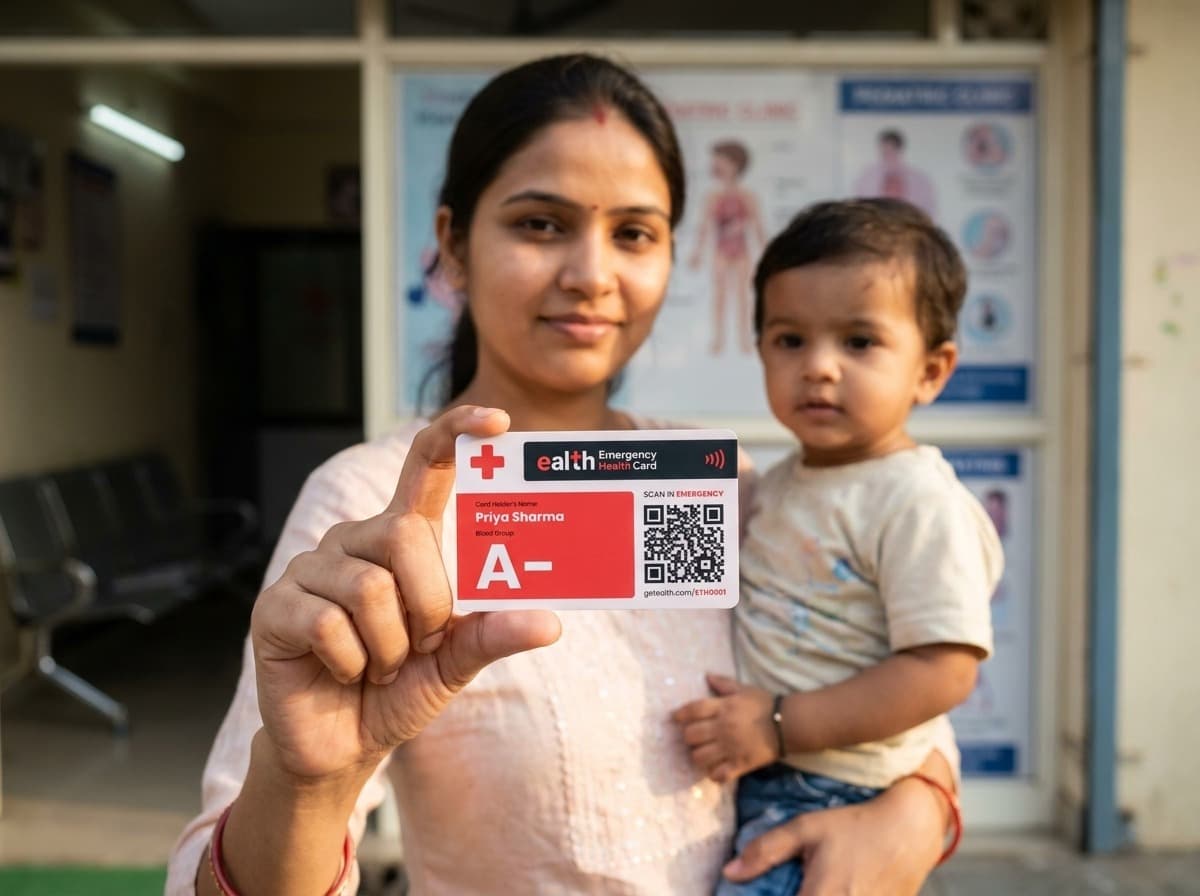
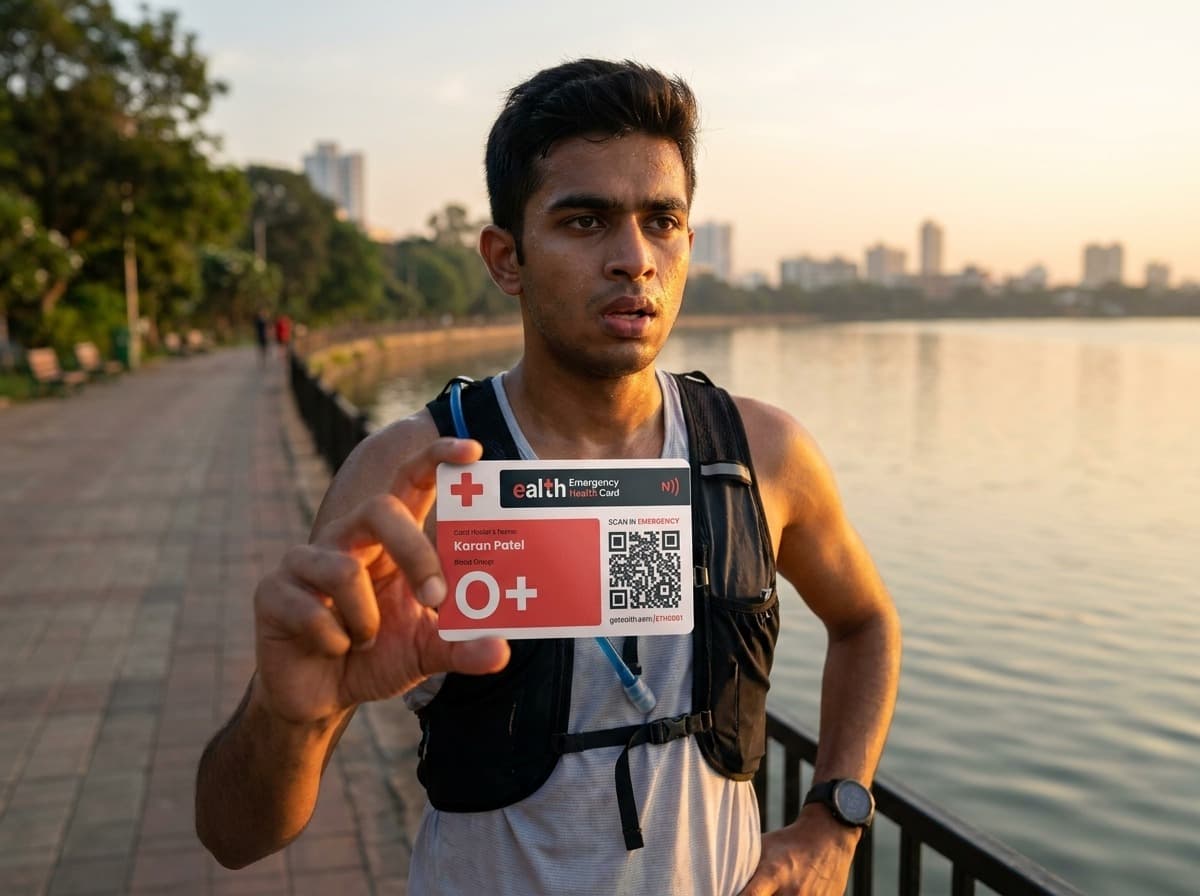
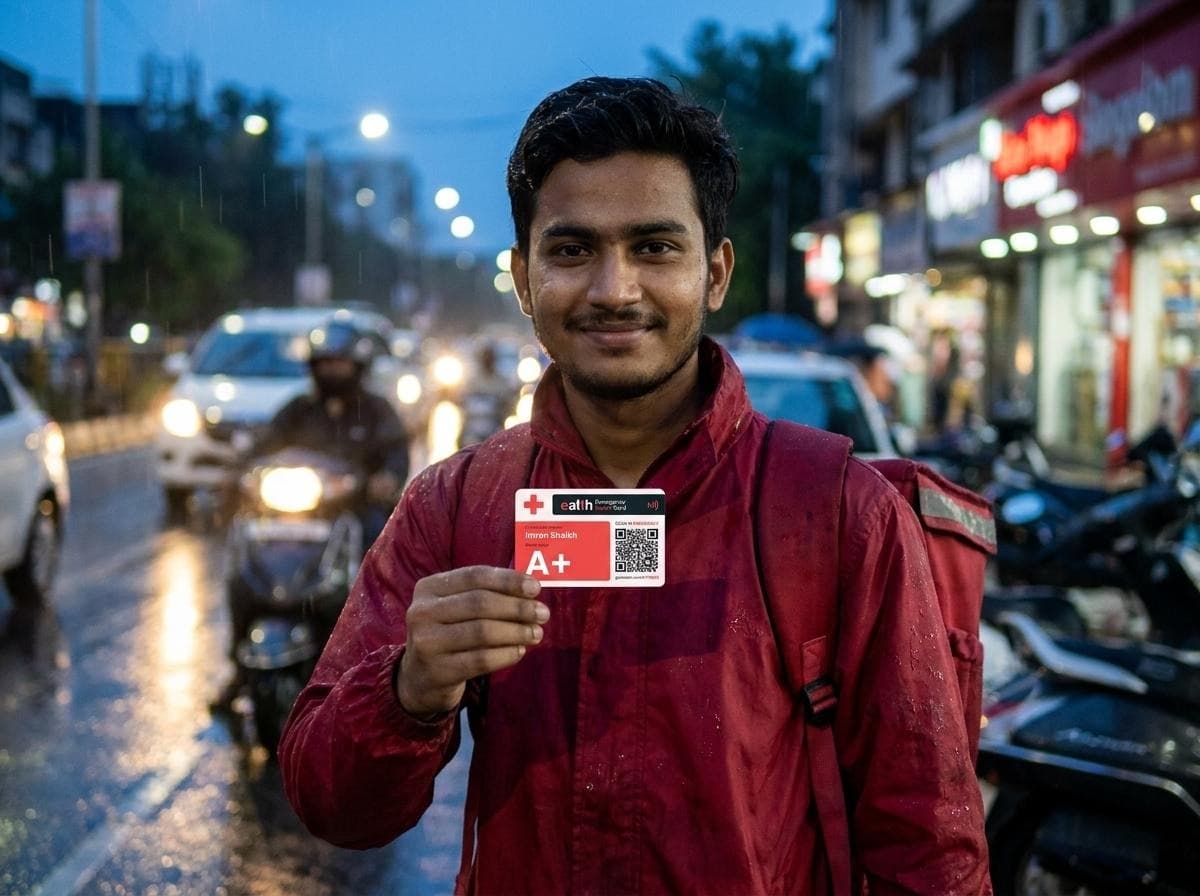
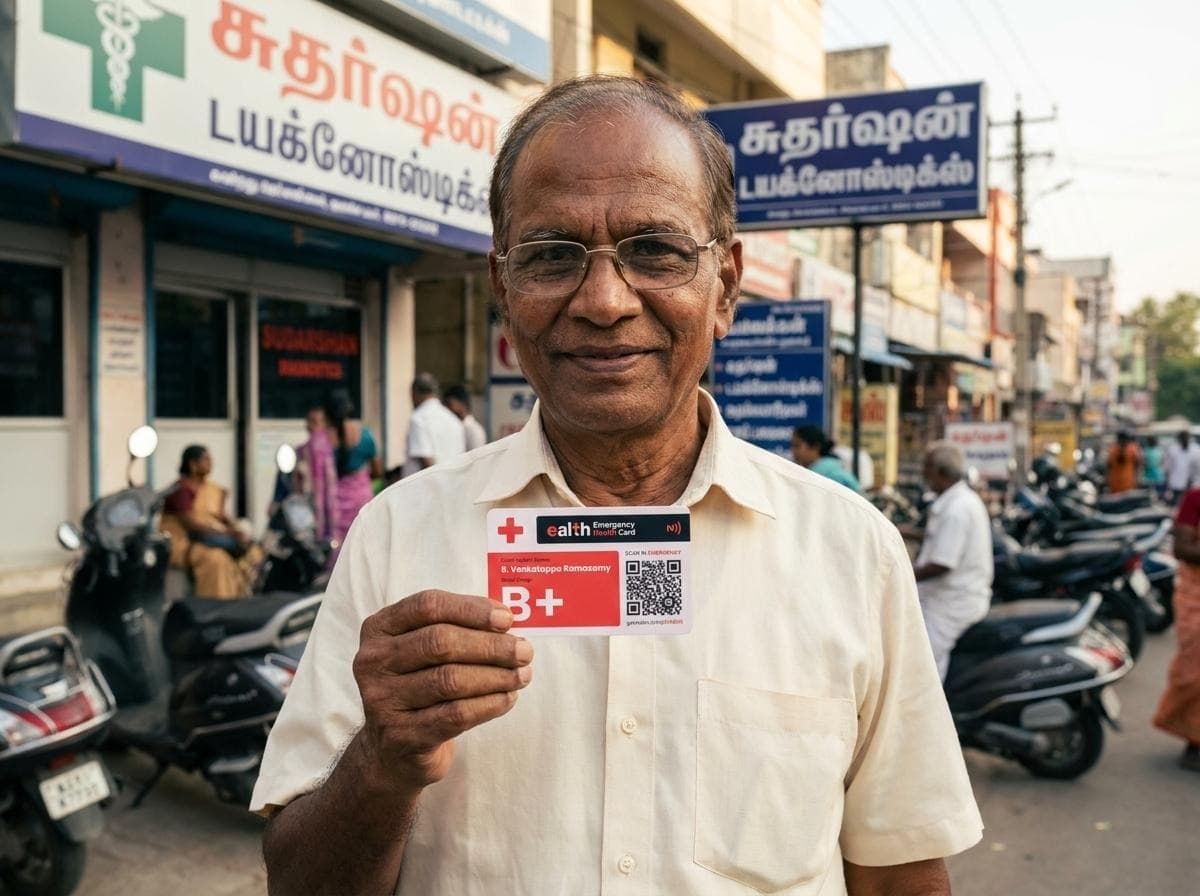
The ealth card is two things running in parallel. For the parent, it is a physical PVC card in the wallet — blood group on the front in large print, QR code and NFC chip on the same surface. When Mrs. Sharma picks up the fallen father and does not know what to tell the ambulance, she taps her phone to the card. The emergency profile opens in under two seconds. Blood group, allergies, current medications, cardiologist's name and number, two emergency contacts with one-tap dialling. This is what the golden hour looks like when someone has prepared for it.
For the child in another country, ealth is the document locker that ends the WhatsApp graveyard. Every BP report, every ECG, every prescription, every ophthalmology report, every diabetes review goes into the parent's profile. Not as a JPEG forwarded in a chat. As a dated, titled document that anyone with profile access can find in under ten seconds by typing a keyword. The sibling in Bengaluru can upload the report from the latest cardiology visit. The child in Toronto can see it that evening. The parent can hand the phone to the next doctor and say 'my children have kept everything here'.
For a family managing one parent's health from abroad, the comparison is not against other apps. The comparison is against the anxiety of not knowing, and the cost of a medical event that was preventable had the right information been available thirty minutes earlier.
How NRI Families Are Setting It Up From Six Time Zones Away
The most common ealth setup pattern for NRI families works like this. The child abroad visits getealth.com, creates a profile for each parent, enters the basic information they already know (blood group, major allergies, current medications), and places the card order with the parent's Indian address. The cards arrive in three to five working days. The sibling or relative nearby helps the parent activate the card by scanning it once to verify it works.
From that point, the document locker is a shared responsibility. The adult child checks in on the next video call: 'Maa, did you go to the cardiologist last month? Ask Priya to photograph the report and upload it to the app.' Priya, the cousin in the same city, uploads the report from her phone. The child in Toronto sees it within the hour. The parent's profile is now current.
What NRI families find, consistently, is that the setup call is the hardest part. Not because the technology is complicated, but because the conversation about emergency preparedness feels like tempting fate. Indian families do not discuss the possibility of a parent collapsing. Once the call is had and the profile is set up, the relief is immediate and lasting. The anxiety does not disappear, but it has somewhere to put itself.
The Conversation to Have on Your Next Video Call Home
Here are the four questions that turn your next Sunday call into a completed ealth setup. What is your blood group? Do you have any drug allergies, especially to aspirin, penicillin, or any blood thinner? What medications are you taking right now and at what dose? Who is the neighbour or nearby relative who can physically reach you within fifteen minutes?
With those four answers, you can complete a parent's emergency profile in under ten minutes. The cardiologist's name and number can be added from a previous prescription photo. The latest report can be uploaded later. The emergency contact you list can be Mrs. Sharma next door, who already has your parents' keys.
Order the card before the call ends. It ships to their address in three to five working days. Tell your mother that the card goes in the wallet where her Aadhaar card used to live. Tell your father that the QR code on the front is the thing the neighbour will scan if he ever cannot speak for himself.
The WhatsApp family group will still exist. The good morning messages will still arrive. But the medical emergency your family has been hoping will never come will, for the first time, have a plan that does not depend on someone finding the right JPEG in a two-year-old chat thread.
Be prepared
Get your Ealth Emergency Health Card
QR + NFC. Blood group laser-engraved. Emergency info accessible to any bystander in under 2 seconds.
Buy your card — ₹499