May 18, 2026 · 8 min read
Nine Delivery Riders Will Die on Indian Roads in the Next Hour. None of Them Will Be Carrying Their Own Name.
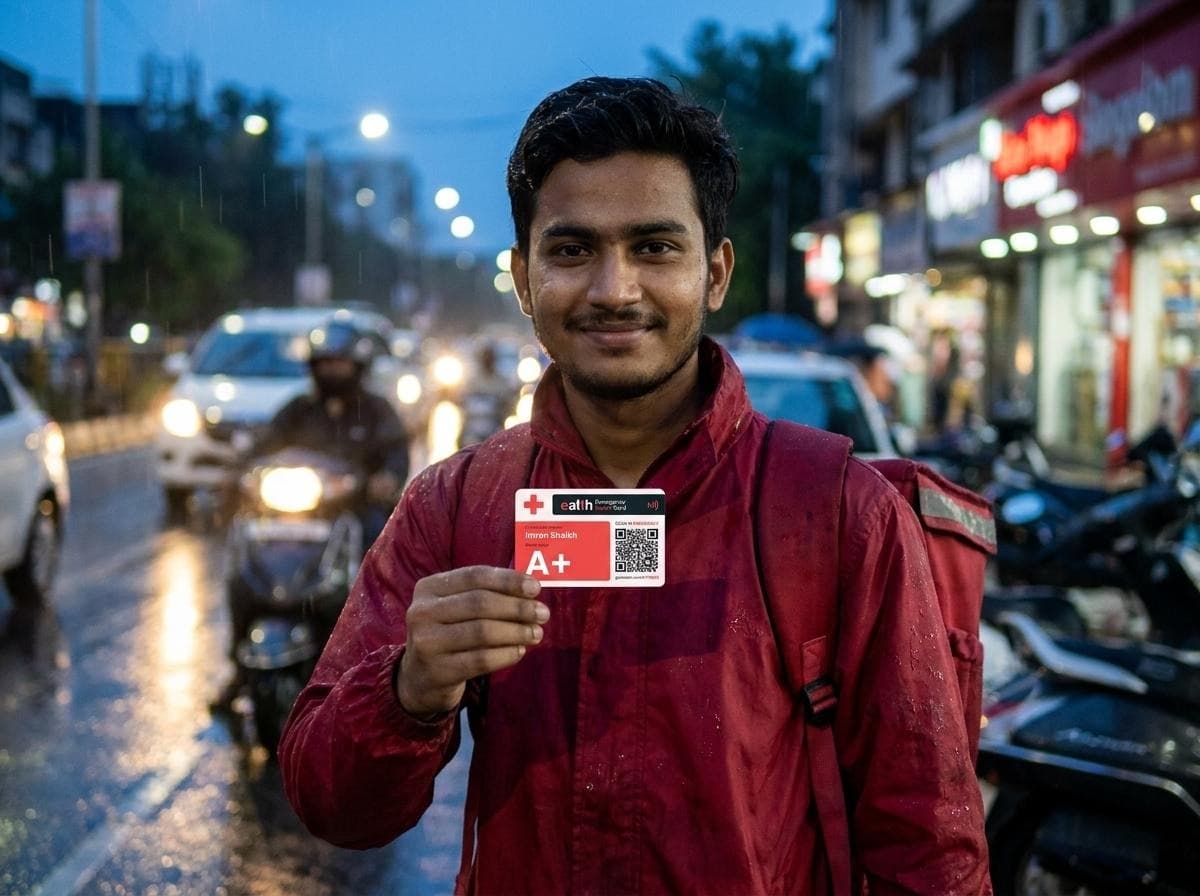
Imran Shaikh, Soaked to the Skin, Holding the One Thing That Will Identify Him
Look at the photo above. Imran Shaikh Ramasamy is standing on a wet Indian street at dusk, in pouring monsoon rain, on the scooter that pays his rent. He is grinning at the camera because he has stopped for thirty seconds between two deliveries to be photographed. His blood group is A positive. His name is printed on the card he is holding up. There is a QR code and an NFC chip on the same card.
This is the version of Imran that exists when everything goes right. The version that worries the rest of us is the one where the rain is heavier, the road is slicker, and the SUV behind him does not see the brake light. That Imran arrives at a government hospital trauma ward as an unconscious young male with a red jacket and no ID. The card in the photo is the difference between those two versions of him.
What the 2023 MoRTH Data Actually Shows About Two-Wheeler Riders
The numbers from the Ministry of Road Transport and Highways' Road Accidents in India 2023 report are the kind that should reshape national policy and so far have not.
Two-wheeler deaths rose from accounting for 30 percent of all road accident deaths in 2014 to 45 percent by 2023. Every hour in 2014, India saw about five deaths of two-wheeler riders on average. This rose to about nine deaths per hour by 2023. Of about 75,000 Indian two-wheeler riders or pillion riders who died in 2023, 73 percent did not wear a helmet.
Nine bike riders. Every hour. Every day. Every year. The 2023 report registered 1,72,890 total road accident deaths, and two-wheeler riders alone accounted for 44.8 percent of them. The single largest category of road death victim in India is no longer the highway truck driver or the careless car passenger. It is the person on the two-wheeler, often working, often racing a delivery clock, often carrying a backpack with someone else's biryani in it.
The Gig Worker Blindspot in India's Crash Records
Here is the fact that should embarrass every policymaker who has spoken about the gig economy as a success story. India's official road crash data sets do not capture profession-specific data or risks, such as those of gig workers, despite the rapid expansion of delivery platforms and quick-commerce segments.
When a Swiggy rider dies on a Bengaluru flyover at 11 PM, MoRTH records a two-wheeler fatality. It does not record that he was on his fourteenth delivery of the day. It does not record that he was wearing a company-branded helmet but no protective jacket. It does not record that he had been on the road for nine consecutive hours. The category 'gig worker' is statistically invisible in the country's most important road safety document.
Independent research has begun filling the gap, and the findings are grim. About 50 percent of 431 gig riders surveyed in Mumbai reported experiencing a crash, and nearly 75 percent reported near-miss incidents. One in two delivery riders in India's commercial capital has been in a road crash. One in 'two'. That is not a workplace hazard. That is an occupational certainty.
Why the Hospital Receives Most Riders as 'Unknown Male, Mid-Twenties'
When a delivery rider is hit on an Indian road, the first responders are almost always strangers. A passing auto driver. A roadside chaiwala. A traffic constable two signals away. None of them know who he is.
His phone is in his pocket, locked. His delivery bag has someone else's order receipt, which identifies the customer, not him. His Aadhaar card is at home, in a drawer, with his wife. The platform he works for has his data in a Bengaluru server, but no bystander on a Surat street has access to it. The ambulance crew can find no medical history, no blood group, no allergy information, and no emergency contact who will pick up an unknown number.
The rider arrives at the trauma ward as 'unknown male, mid-twenties, RTA' on the admission slip. The hospital begins a slower default protocol for unidentified patients. O-negative blood is drawn from the bank for transfusion because nobody knows his actual group. The police photograph his face and circulate it on a WhatsApp group of beat constables, hoping someone recognises him. His family finds out twelve to thirty hours later, sometimes only when he does not return home and they begin calling hospitals one by one.
None of this is hypothetical. It is the documented experience of delivery rider families across Indian cities. It is the cost of being economically essential and bureaucratically invisible at the same time.
What Platforms Have Done, and Where the Gap Still Sits
To be fair to the platforms, several have moved on rider safety in the last three years. Zomato and Swiggy both provide accident insurance to active riders. Riders complete a mandatory road safety module, are told not to overspeed or break traffic rules, and are not penalised for delays. Partners are provided health and accident insurance and have access to ambulance assistance and rest points nationwide.
These are real steps. But they all share a single design flaw: they assume the rider is awake, conscious, and able to operate his phone after the accident. The insurance is excellent if you can call the helpline. The ambulance assistance is excellent if you can open the app and tap the SOS button. The rest points are excellent if you can ride yourself to one.
For an unconscious rider lying on a wet road, none of these protections activate. The platform's safety net is real, but it begins one step after the moment that matters most. The gap is not in policy. The gap is in identification.
What Ealth Solves That Insurance Does Not
Ealth is a PVC card or a small keyfob. It costs ₹499, a one-time payment with lifetime access, no subscription. It has a QR code on the front and an NFC chip embedded inside. Any bystander with any smartphone made in the last seven years can tap or scan it. The emergency profile opens in under two seconds. No app to download. No login screen. No password to remember.
What the bystander sees is built for thirty seconds of panic. Blood group at the top of the screen, in the largest font. Allergies in red. Two emergency contacts with one-tap call buttons. The rider's full name. His preferred language for medical conversation, if he speaks Tamil, Bengali, or Marathi better than Hindi. His preferred hospital, if his family has one. A photograph so the paramedic can confirm identity if his face is bandaged.
The physical card also has the blood group printed on the front in large type. Even with no phone, no network, and no scanning, the most critical piece of information is readable by a human eye in poor light. The card is designed for the exact conditions in Imran's photograph above: monsoon rain, low visibility, panicking strangers, and a phone that may not be powering on.
This is not insurance. Insurance pays the family after. This is identification. Identification keeps the rider alive in the window before.
The Quiet Way Indian Customers Are Stepping In
Over the last few months, something unplanned has started happening on the ealth order page. A small but growing number of orders come with a note: 'this card is for the delivery rider who brings my groceries every week, please ship to his address'. Or: 'I want to gift three cards to the Rapido riders in my apartment complex'. Or, from corporate accounts: 'we want to sponsor 200 cards for the gig workers in our partner network'.
Indian customers, it turns out, do know the riders. They know that Suresh delivers their Zepto order. They know that Mohammed is the Swiggy guy who never gets the address wrong. They know that the Blinkit rider waved at their daughter on her birthday. The relationship is more human than the apps make it look.
A ₹499 gift card to a delivery rider is a strange and powerful gesture. It is not a tip. It is not charity. It is one Indian saying to another, 'if something happens to you on the road today, the people who help you should know who you are.' For the rider, it is often the first time anyone has spent money on his identification rather than his speed.
How to Gift a Card to a Rider You Know
Setting up an ealth card for a delivery rider takes about five minutes on getealth.com. You can either order it in his name (with his consent and details) or order an unactivated card and hand it to him so he can set it up himself in his own language. The app supports profile entry in Hindi, Marathi, Gujarati, Tamil, Telugu, Kannada, Bengali, and English. The setup form is short and designed for first-time users who may be more comfortable typing in their native script.
The card ships within forty-eight hours, anywhere in India. The digital profile is live the moment setup is complete, so the QR link works from day one. It is a one-time ₹499, for lifetime access, no renewal. For a customer who spends ₹500 a week on quick commerce, gifting a card to the rider who delivers those orders is the same money for a single week, redirected once towards the person who carries the risk.
For platforms reading this: the same gift, scaled. A few hundred rupees per rider, multiplied across your fleet, is the single most cost-effective rider safety intervention available in the Indian market today. Helmets reduce fatality risk by 30 to 40 percent. Identification cuts the unidentified-patient delay to zero. The two are not substitutes for each other. They are partners.
Nine bike riders will die in India in the next hour. Most of them will be carrying someone else's order and nothing of their own. The least an Indian household can do, the least an Indian platform can do, the least an Indian city can do, is make sure that when the worst happens, the person on the ground has a name.
Be prepared
Get your Ealth Emergency Health Card
QR + NFC. Blood group laser-engraved. Emergency info accessible to any bystander in under 2 seconds.
Buy your card — ₹499