May 18, 2026 · 8 min read
You Have CE Level 2 Armour, a ₹40,000 Helmet, and a GoPro Mounted on Your Tank. You Are Still Riding Without the One Thing Every Indian Tour Leader Wishes You Carried.
The Gear Conversation Indian Riders Have Not Yet Had
Walk into any serious rider's garage in 2026 and the gear conversation will sound like a small symphony. The jacket is Rynox or Royal Enfield Streetwind, CE Level 2 armour at the shoulders and elbows, back protector inserted. The helmet is an Axor Apex or an LS2 Thunder, sometimes a Shoei or Arai for the riders who fly back from Bangkok with one in their hand luggage. The gloves are knuckle-protected leather. The boots are above-ankle, oil-resistant. The bike has crash guards, a sump guard, hand guards, and a GoPro on the chin mount. There is a Cardo or Sena intercom between rider and pillion. The GPS is a Garmin Zumo or a phone in a quad-locked waterproof case. The riding pants have hip and knee armour.
This is a community that has taken safety seriously and built a vocabulary around it. CE Level 2, AGV-rated, ECE 22.06, SAR D3O. These are everyday phrases in Indian biking WhatsApp groups now. The conversation has matured beyond the helmet-on-helmet-off debates of the early 2010s.
What the conversation has not yet covered is the post-impact moment. Every piece of gear in the previous paragraph is designed to reduce the severity of the crash itself. None of it is designed for the thirty minutes after the crash, when the rider is unconscious on the shoulder of a highway and the strangers around him are trying to figure out who he is.
What the Data Actually Says About Indian Motorcycle Accidents
The Ministry of Road Transport and Highways' 2023 report places two-wheelers at the centre of India's road safety crisis. Two-wheelers accounted for 44.8 percent of all road accident deaths in India in 2023, the highest of any vehicle category. Of the roughly 75,000 two-wheeler riders or pillion riders who died, 73 percent were not wearing helmets. Two-wheeler deaths have nearly doubled in the decade leading up to 2023, rising from accounting for 30 percent of all road deaths in 2014 to 45 percent in 2023.
The sub-category data is sobering. Independent analysis of motorcycle accident causes in India places speeding at the top, contributing to roughly 37 percent of motorcycle accidents. Not wearing a helmet accounts for an additional 25 percent of fatal outcomes, with alcohol involvement adding 15 percent. The committed touring rider is statistically protected from the helmet failure and usually the alcohol failure. He is not protected from the speed failure, because long highway days build their own momentum, and he is not protected at all from the failures of other drivers around him.
The Indian touring community is, on the whole, a more careful subset of the broader two-wheeler population. The problem is that the broader two-wheeler population is the population it shares the road with.
Why Touring Increases the Stakes, Not Just the Distance
City accidents have a built-in safety net. The hospital is fifteen minutes away. Somebody on the street knows the local trauma centre. Family is reachable. The pharmacy is around the corner. Even the worst city crash exists inside a dense web of available help.
Touring inverts every one of these. On the Manali-Leh highway, the fuel gap between Tandi and Karu is roughly 365 kilometres. That is the petrol situation. The medical situation is worse. The nearest equipped hospital for a serious trauma case may be six hours of mountain driving away. The mobile network drops out for stretches. The strangers who reach you first are not urban Indians used to the city emergency protocol. They are local villagers, fellow tourists in cars, or other riders on the same route. They want to help. They have no information to help with.
The touring rider is also often alone or with a small group of friends who do not know his medical details. The wife who knows his BP medication brand is in Bengaluru. The cardiologist's number is in his phone. The phone is shattered or locked. The Aadhaar card is in the tank bag, which is now thirty metres away in a ditch. The four-and-a-half-hour stroke window or the golden-hour trauma window starts ticking from the moment of impact, but the information transfer that would shorten the hospital protocol is locked away in three different cities.
The Ladakh and Spiti Scenarios Nobody Plans For
Two specific touring scenarios produce most of the serious medical evacuations from Indian high-altitude routes, and neither is what new riders worry about most.
The first is acute mountain sickness. The geography of Ladakh puts the average baseline elevation at over 3,500 metres, where oxygen levels are roughly 65 percent of those at sea level. AMS is the primary reason for tour curtailment and medical evacuations on Ladakh routes. It does not announce itself at the airport. It announces itself two days into the trip, often at night, often with a rider who pushed past Khardung La on day one because he 'felt fine'. The progression from headache to High Altitude Pulmonary Edema can be alarmingly quick. The riders around him need to communicate his medical history to a remote clinic in Leh or Kargil, and most of them will not know it.
The second is the single-vehicle crash. The straight-stretch crash on the More Plains. The patch of black ice on a switchback. The unexpected stream of melting snow across the road in July. The 2017 study of motorcycle fatal crashes on Indian national highways consistently shows that the majority of fatal motorcycle crashes occur on straight stretches, not on the curves riders fear in advance. The mistake is rarely dramatic. The consequences are.
What Tour Leaders Quietly Wish Every Rider Carried
Speak to any experienced Indian tour leader, the people who run guided Ladakh, Spiti, North East, and Rajasthan groups, and the wishlist for participants is remarkably consistent. They want every rider to carry: a printed copy of the rider's blood group and emergency contact in the tank bag, a wallet card with the same information, a clear note on regular medication and allergies, and ideally a designated 'medical buddy' within the group who knows where these documents live.
What tour leaders actually receive from participants is: a verbal mumble about blood group that may or may not be accurate, a phone with a locked screen, and an emergency contact stored as 'Wifey' or 'Maa' with no second number in case the first is unreachable.
The gap between what tour leaders want and what riders actually carry is not a moral gap. It is a tooling gap. Nobody has, until very recently, sold a single product that consolidates blood group, allergies, medications, two emergency contacts, and a photo into one piece of plastic that any stranger on a Ladakh switchback can read in two seconds. That product now exists, and the people who run guided tours for a living are starting to make it part of their pre-trip checklist.
What Ealth Does That Your ICE Contact in the Phone Cannot
Most Indian riders, on reading the previous sections, will quietly think: 'I have In Case of Emergency contacts saved in my phone. I have set up the medical ID on iOS. I should be fine.' This is the assumption ealth was specifically built to address.
The iOS Medical ID and Android Emergency Information features are excellent, in theory. In practice, they require the bystander to know the exact swipe pattern on a locked screen, in the model and OS version the rider happens to be using, under high stress, often with a damaged phone. Indian riders ride a wide mix of iPhones, Samsungs, OnePlus, Xiaomi, and Realme devices. The bystander is not going to know which is which, especially if the screen is cracked and the phone is partly buried in dust or mud.
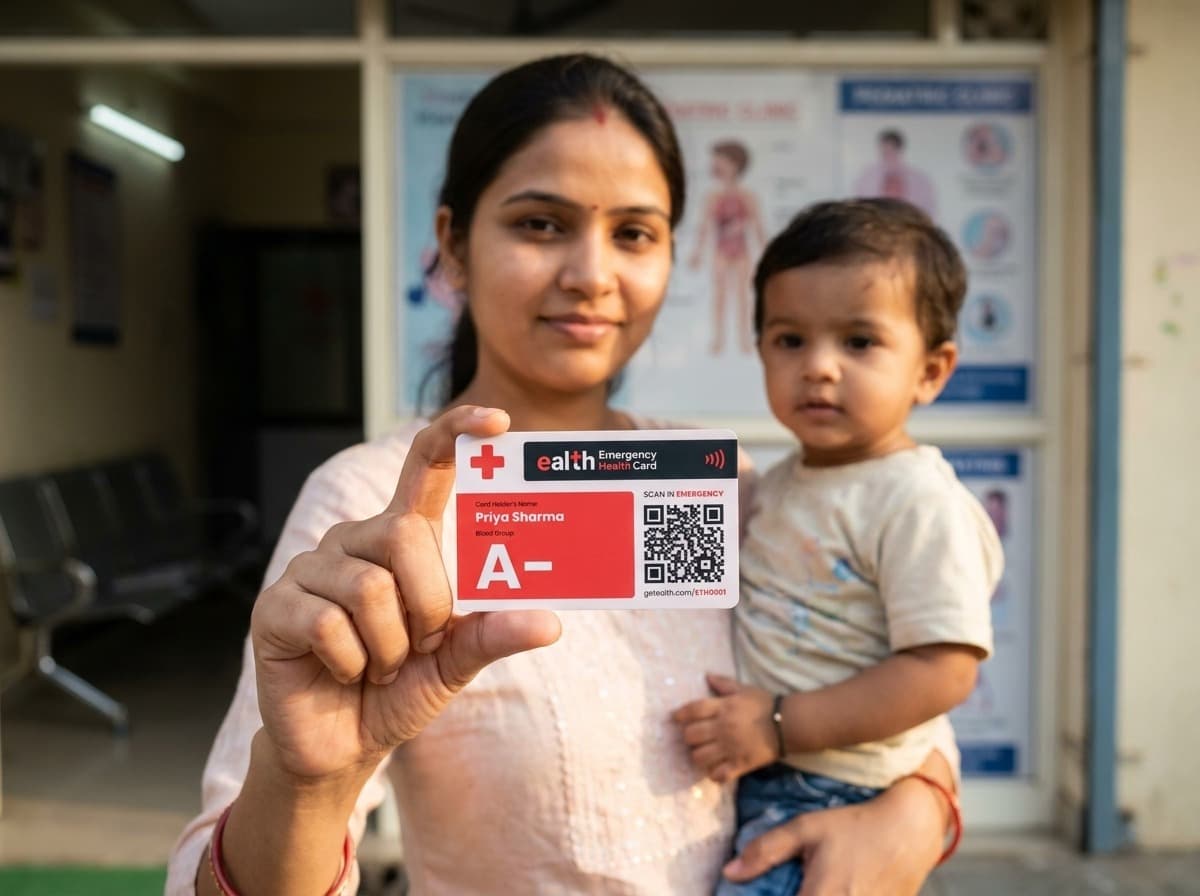
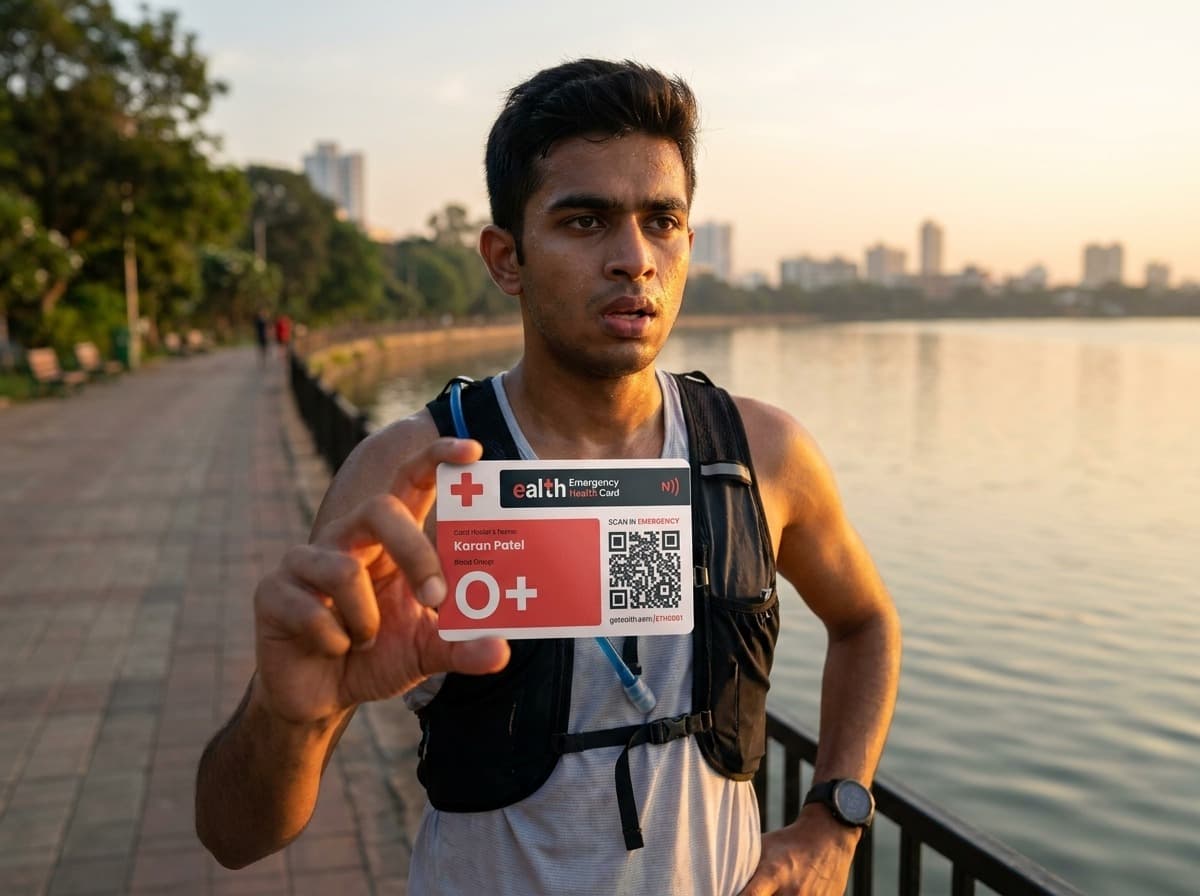
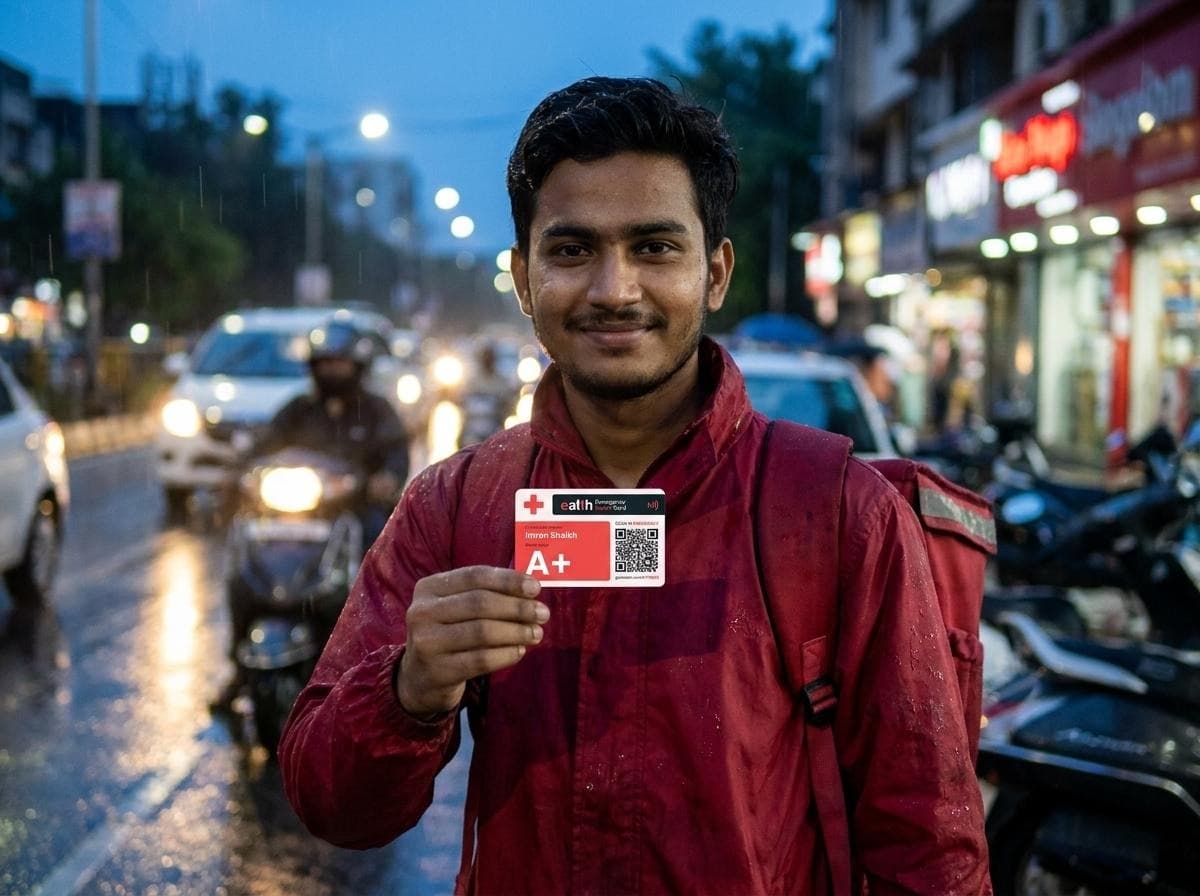
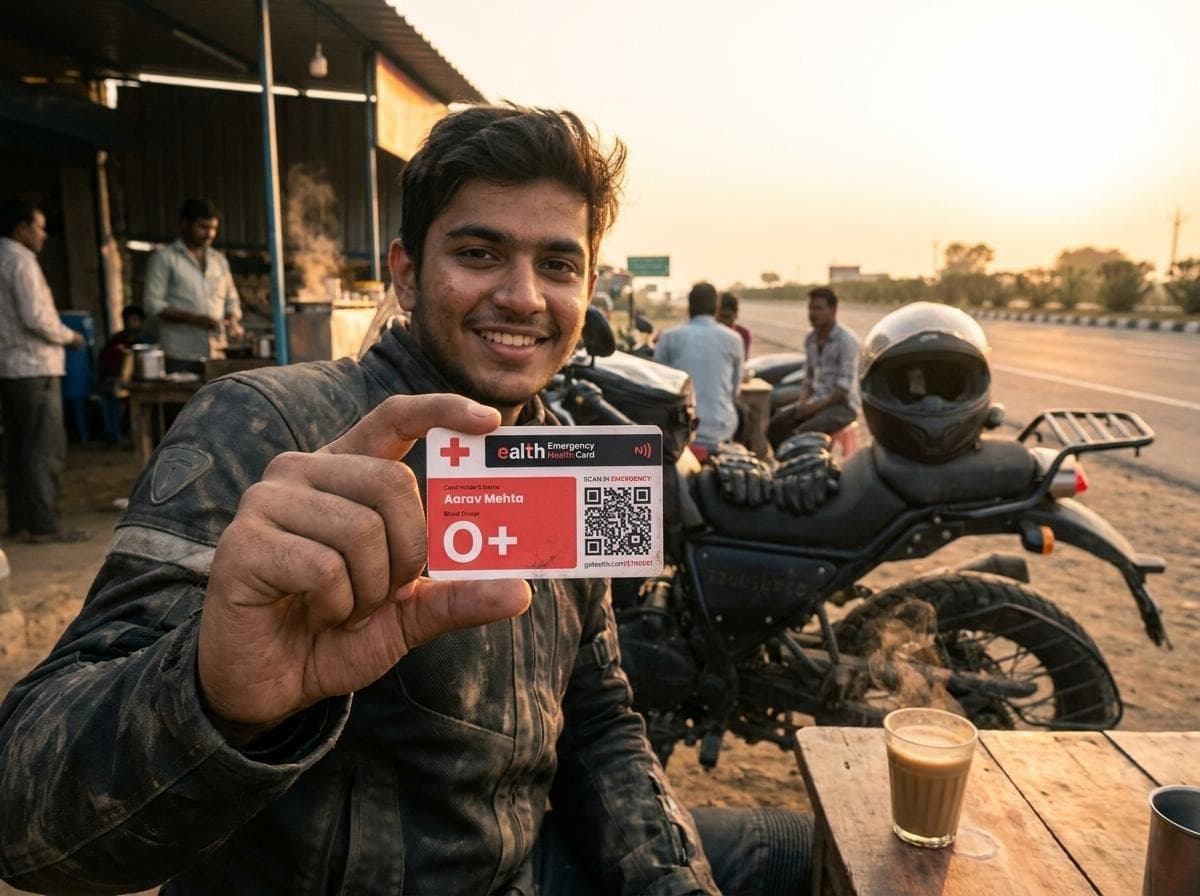
The ealth card removes the entire problem. It is a PVC card the size of a credit card, or a small keyfob that clips onto a tank bag, hydration pack, or jacket zipper pull. The QR code on the front is scannable by any smartphone made after 2017. The NFC chip inside is readable by any iPhone since the 7 and most Android phones since 2018. Either action opens the emergency profile in under two seconds. No app to download. No login screen. No password.
The profile is built for the stressed stranger. Blood group at the top, in the largest font on the screen. Allergies in red. Two emergency contacts with one-tap call buttons. Cardiologist or family doctor's name if added. Preferred hospital if specified. Photograph for identity confirmation if the rider's face is obscured by injury or a removed helmet. The physical card also has the blood group printed on the front in large type, readable without any phone at all, useful in exactly the kind of mountain or desert dead zone where touring accidents tend to happen.
How Riding Groups in Surat, Pune, and Bengaluru Are Adopting It
Over the last few months, the most interesting ealth order pattern has come from organised riding groups. A WhatsApp admin orders 18 cards in one go for the next Ladakh group. A motorcycle dealership in Pune bundles a card with every Royal Enfield Himalayan delivery as a value-add. A tour operator in Bengaluru includes a card in the welcome kit for every Spiti booking.
The economics make this easy. ₹499 per card, a one-time lifetime fee, is a small fraction of a tour cost, but the upside is significant. Tour operators report that participant families ask sharper questions about medical safety after watching three or four bike vlog channels on YouTube. Having a documented emergency ID system for every rider is the kind of detail that closes a booking, especially when the participant's spouse or mother is the one signing the cheque.
For solo riders not in a group, the maths is simpler. Most touring riders spend ₹15,000 to ₹40,000 on a helmet, ₹12,000 to ₹25,000 on a jacket, several lakhs on the bike itself, and easily ₹50,000 on a guided Ladakh trip. Against that, ₹499 for lifetime access, one-time, no subscription, is not the friction. It is an awareness conversation.
Setting It Up Before Your Next Long Ride
Setup takes about five minutes on getealth.com. You enter your name, blood group, allergies, current medications, any heart-relevant or altitude-relevant condition (a known history of mild AMS, for instance, is worth flagging), and two emergency contacts. You pick the card or the keyfob. Most touring riders go for both: card in the wallet, keyfob clipped to the tank bag zipper or hydration pack strap.
The product ships within 48 hours and arrives in three to five working days, anywhere in India. The digital profile is live the moment you finish the form, so the QR link is functional from day one, even before the physical card reaches you. For a touring rider, the maths is not the friction. The friction is the small admission that the gear list, the one you spent three years assembling, has had a hole in it the whole time.
The next time you load up for Ladakh, Spiti, the Western Ghats run, or the Rann of Kutch loop, the card sits in your wallet doing nothing. On the day it is needed, it does the one thing nothing else in your kit can do. It tells a stranger who you are, fast enough for it to matter.
Be prepared
Get your Ealth Emergency Health Card
QR + NFC. Blood group laser-engraved. Emergency info accessible to any bystander in under 2 seconds.
Buy your card — ₹499