May 18, 2026 · 8 min read
She Landed in a City Where Nobody Knew Her Name, Her Blood Group, or the One Medication That Could Have Killed Her
The Ordinary World: A Passport, a Boarding Pass, and a False Sense of Safety
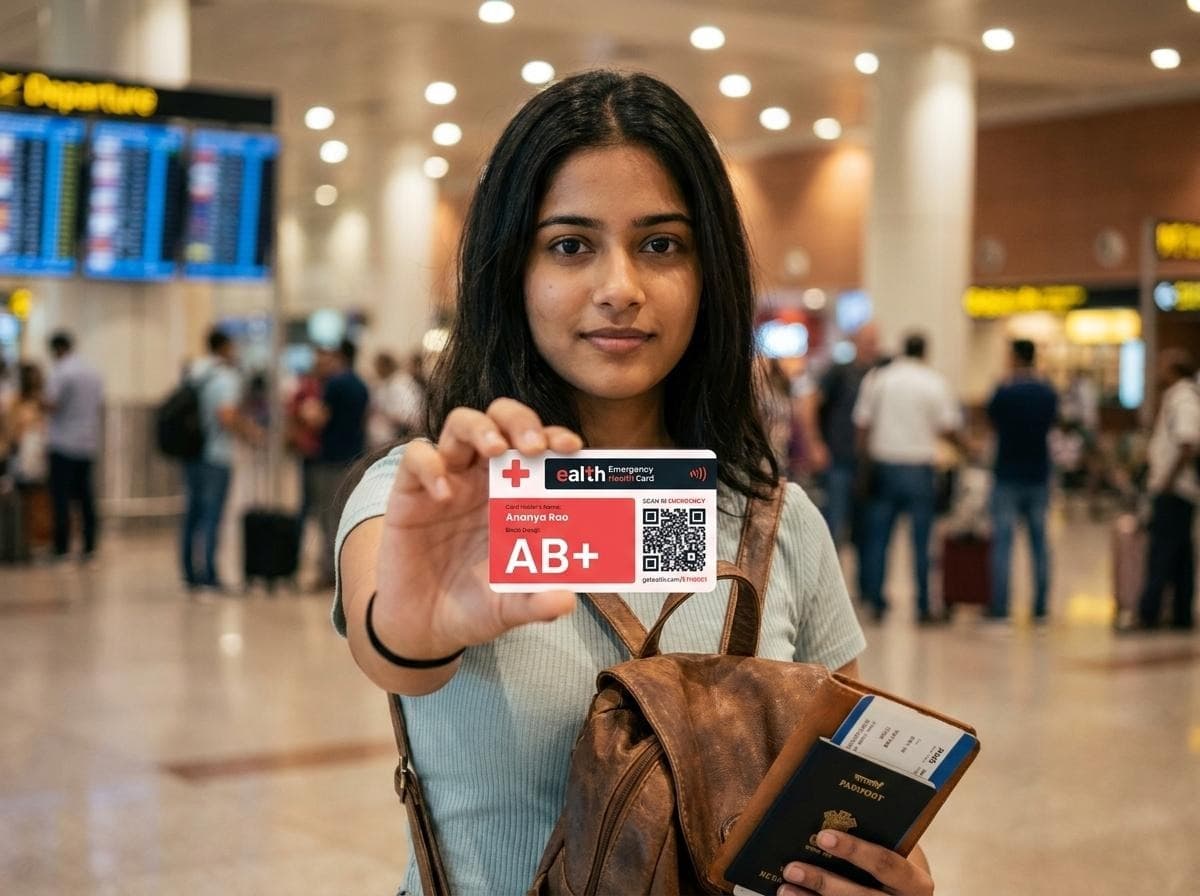
Picture Ananya at the international departures terminal. Backpack on one shoulder, passport and boarding pass tucked under her arm, eyes already on the gate number. She has done everything a careful traveller does. Visa printed. Forex card loaded. Hotel booking saved offline. Travel insurance purchased in the last anxious hour before checkout. Google Maps downloaded for the destination city.
She feels prepared, and on paper she is. But every single thing she has organised is built around the assumption that she will be awake, conscious, and able to operate her own phone. The insurance helpline needs her to call it. The hotel booking needs her to show it. The maps need her to read them. Her entire safety net is designed for the version of her that is fine.
This is the ordinary world of the modern Indian traveller. Hyper-prepared for every scenario except the one where she cannot speak for herself. And that scenario, statistically, is the one that travel makes more likely, not less.
The Call: The Question She Could Not Answer at 30,000 Feet
Here is the call to adventure, except it does not feel like an adventure. It feels like a cold drop in the stomach.
Imagine a fellow passenger collapses mid-flight. The cabin crew make the announcement: is there a doctor on board? A doctor steps up. The first questions are the universal ones. What is the patient's blood group? Any known allergies? Any medication? The travelling companion does not know. The crew check the passport. A passport has a photo, a name, a nationality, and a number. It does not have a single piece of medical information on it. Neither does the boarding pass. Neither does the locked phone in the seat pocket.
Now flip it. Imagine it is Ananya who collapses, in a foreign airport, in a city where she knows nobody, in a country where the emergency operators may not speak Hindi or even fluent English. The people trying to save her have her passport in their hands and still know nothing about how to treat her safely. This is the moment the entire trip has quietly been building toward, and it is the one moment she did not prepare for.
The Refusal: Why We All Assume the Phone Has It Covered
Most travellers, reading this, feel a small internal objection forming. 'I have my medical details in my phone. I set up the Health app. I have my doctor's number saved. I will be fine.' This is the refusal of the call, the very human instinct to believe the problem is already solved.
It is worth being honest about why this belief does not hold. Your medical information is scattered across apps that all require you to be conscious. Your prescriptions are in one pharmacy app. Your lab reports are in a diagnostic chain's app. Your doctor consultations are in a teleconsultation app. Your fitness data is in another. Your insurance is in a portal you log into once a year. And every one of these sits behind a phone lock that opens only with your face or your fingerprint, the two things an unconscious person cannot provide.
The iOS Medical ID and Android Emergency Information features exist, and they are genuinely useful, but they require the stranger to know the exact swipe path on your specific phone model under extreme stress, in a foreign airport, possibly with a cracked screen. The refusal feels reasonable. It just does not survive contact with the actual scenario.
The Mentor: A Card Built for the Stranger, Not for You
Every hero's journey turns on the arrival of the mentor, the one who hands over the tool that makes the rest of the story possible. In this story, the mentor is not a person. It is a card, and the crucial thing about it is that it was not designed for you. It was designed for the stranger who finds you.
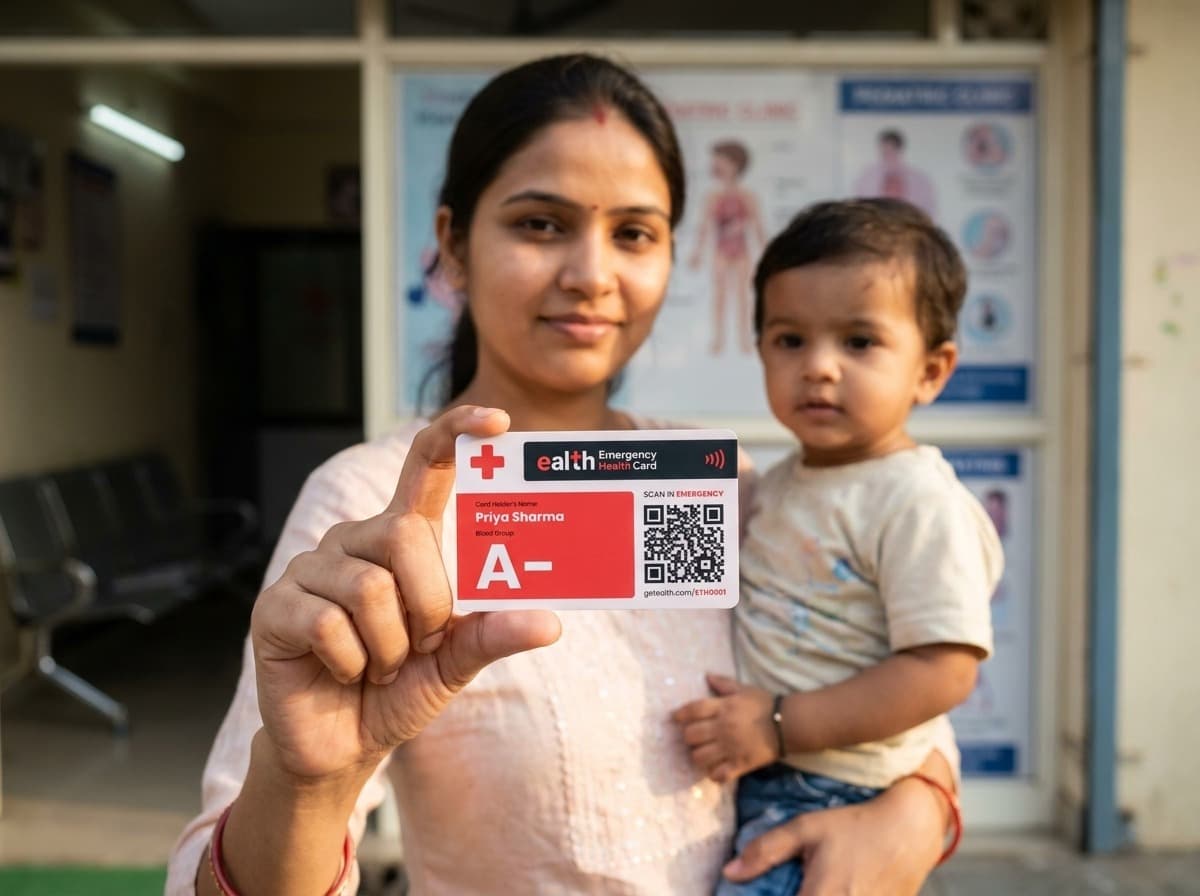
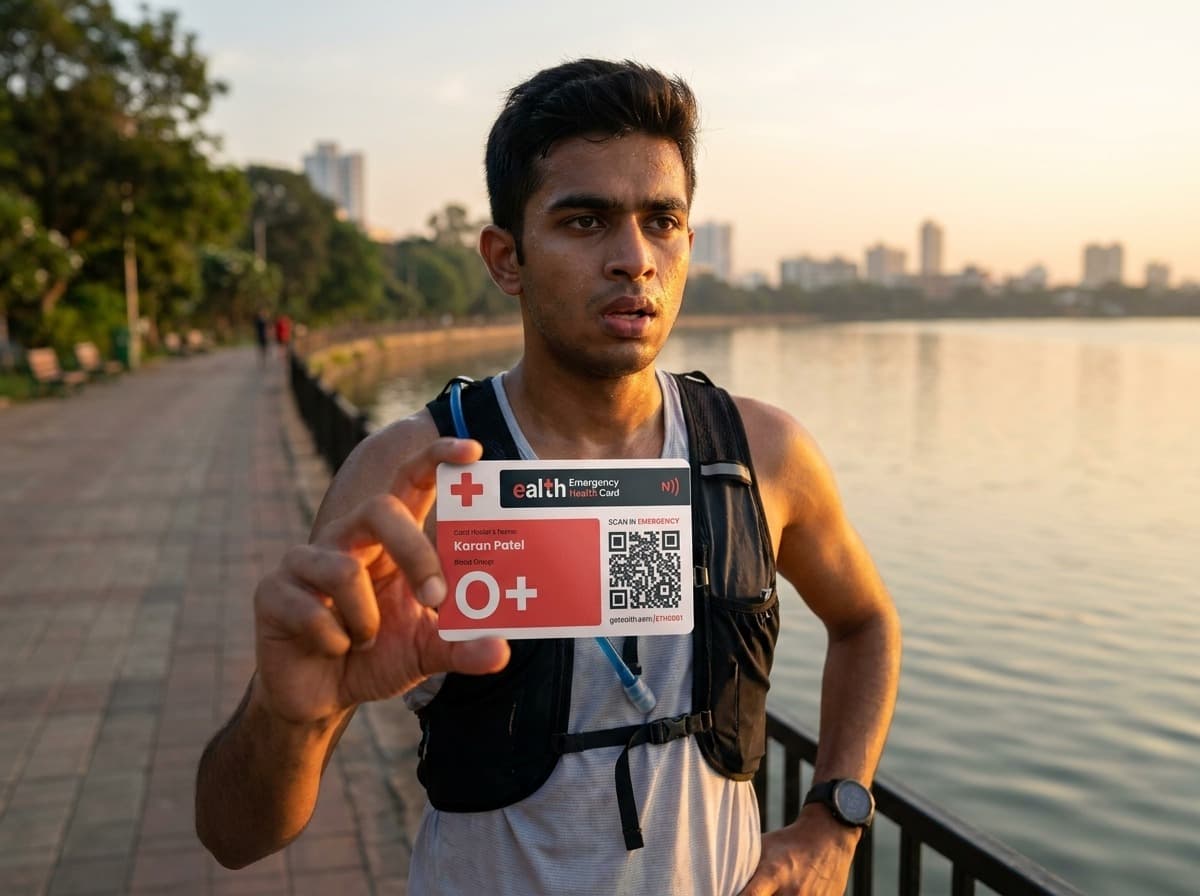
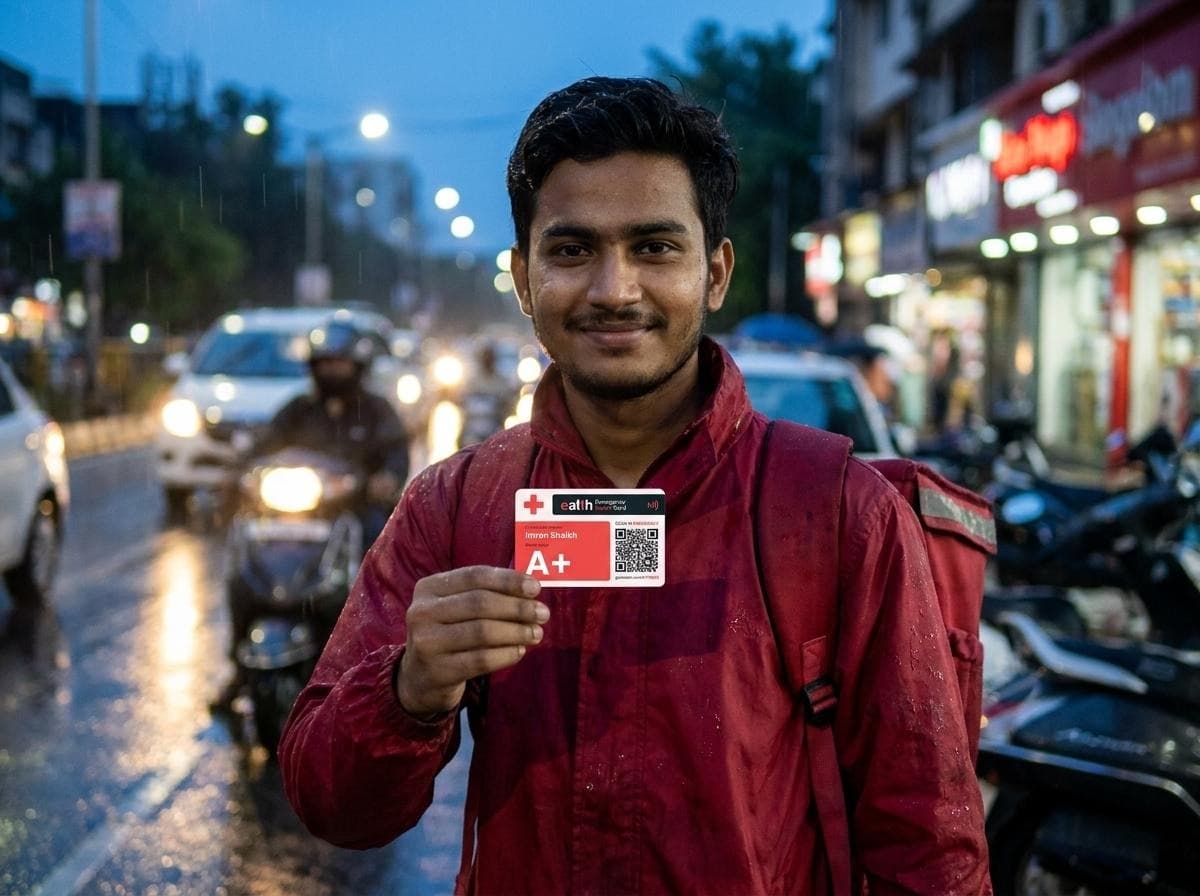
The ealth Emergency Health Card is a PVC card the size of your credit card, or a small keyfob that clips onto your backpack zipper or passport holder. It carries a QR code on the front, scannable by any smartphone made after 2017, and an NFC chip inside, readable by any iPhone since the 7 and most Android phones since 2018. A stranger taps or scans it and your emergency profile opens in under two seconds. No app to download on their side. No login. No password.
What opens is a single screen built for thirty seconds of panic. Blood group at the top, in the largest font. Allergies in red. Two emergency contacts with one-tap call buttons, ideally one in India and one at your destination. Your critical medications and conditions. A photo to confirm your identity. The physical card also has your blood group printed on the front, readable by a human eye even with no phone, no signal, and no shared language. It speaks for you in the exact moment you cannot speak for yourself.
Crossing the Threshold: What Changes the Moment You Carry It
The threshold in this journey is small and almost invisible from the outside. You set up your profile, the card arrives, you slip it into your wallet next to your forex card. Nothing about your trip looks different. You still board the same flight, see the same sights, eat the same questionable street food on day three.
What changes is underneath. For the first time, the medical version of you travels with you, not locked inside a device, but readable by anyone who needs it. The fellow passenger, the foreign paramedic, the hotel front desk, the local hospital admissions clerk, all of them can now learn in two seconds what previously would have taken hours of phone calls to India to assemble, if it could be assembled at all.
Crossing this threshold does not make you anxious. It does the opposite. The careful traveller who has thought about this stops carrying the low background hum of 'what if something happens to me out here'. The card has answered it. You travel lighter in the way that actually matters.
The Trials: Three Places Where It Quietly Earns Its Keep
Every journey has its trials, the moments that test whether the preparation was real. For the traveller, the card earns its place in three recurring ones.
The first is the foreign hospital. Different country, different language, different drug brand names, an admissions process that treats an unidentified foreign patient with maximum caution and minimum speed. A scanned ealth profile collapses that delay. The receiving doctor sees blood group, allergies, and medications in their own reading time, not after a translated phone call to a relative six time zones away.
The second is the remote domestic trip. The Northeast, the Andamans, a Himalayan trek town, a Rann of Kutch road trip. Places where the nearest real hospital is hours away and the people around you are locals who want to help but have no information. The printed blood group on the card works even where the mobile network does not.
The third is the simplest and most common. The ordinary solo trip where nothing goes wrong, but where the quiet knowledge that you are reachable lets you actually relax. Most trials are passed without drama. The card's value is that it is ready for the one that is not.
The Return: Travelling as the Person Who Is Always Reachable
The hero returns transformed, carrying something back for the people who did not make the journey. For the traveller who adopts this habit, the transformation is a shift in identity. You stop being a person whose medical existence ends at the boundary of your unlocked phone. You become a person who is identifiable, reachable, and treatable anywhere on earth, conscious or not.
The elixir you bring back is not just for you. It is the example you set for the people who travel with you and after you. The friend who sees your keyfob on your backpack and asks about it. The younger cousin heading abroad to study who you quietly set up before they fly. The parents you finally convince to carry one on their pilgrimage circuit. The habit spreads the way good travel habits always have, by example, from the person who learned it the considered way.
This is what it means to travel as the person who is always reachable. Not fearful. Not paranoid. Simply prepared for the one scenario that all your other preparation forgot.
Your First Step Before the Next Trip
Setup takes about five minutes on getealth.com. You enter your name, blood group, allergies, current medications, any pre-existing condition, and two emergency contacts, ideally one in your home city and one reachable at your destination. You pick the card, the keyfob, or both. The product ships within 48 hours and arrives in three to five working days, anywhere in India.
Your digital profile goes live the moment you finish the form, so even if you are flying this week and the physical card has not arrived, your QR link is already functional and shareable. For a traveller who spends thousands on insurance they hope never to use, this is the smaller, smarter cousin of that same instinct, the one that works even when you cannot reach for your phone to make the claim.
Before the next trip, before the next gate number, before the next departures board, set this up. The most prepared thing you can carry is the one that speaks for you when you cannot.
Be prepared
Get your Ealth Emergency Health Card
QR + NFC. Blood group laser-engraved. Emergency info accessible to any bystander in under 2 seconds.
Buy your card — ₹499